Platforms · 2024 · Live
Absence Labs Platform
Comprehensive enterprise platform integrating a custom LMS and dynamic certificate generation.
- Role
- Founder & Engineer
- Duration
- Completed
- Team size
- Solo
Project overview
What this product is
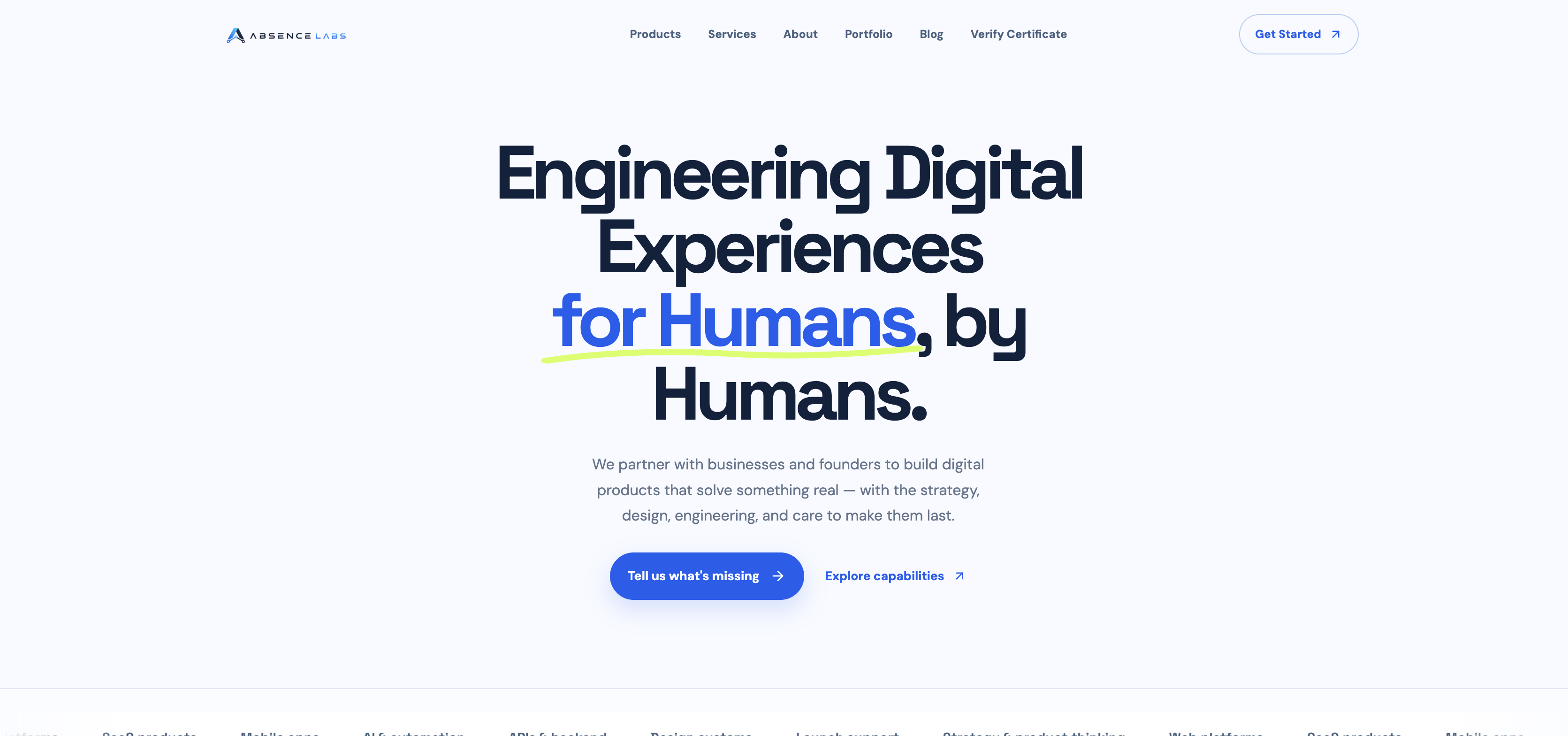
Absence Labs is the independent studio behind ReCode IDE — and this platform is its operational front door: the brand site, the product hub, a changelog engine, and the waitlist infrastructure that every launch plugs into.
I designed and built it in six weeks as a system, not a page: content is MDX, products register themselves, and every launch reuses the same waitlist, changelog and announcement rails.
The problem
Why it existed
A studio with multiple products needs a coherent public surface — but each launch tends to spawn a separate landing page, a separate email list and a separate 'we'll add it to the site later' debt.
Who experienced it
Independent studios and small product companies juggling several products with one brand.
Why current solutions weren't enough
Website builders produce disconnected pages; full marketing suites are overkill and still don't model 'a studio that ships products'. The connective tissue — waitlists, changelogs, cross-product discovery — usually doesn't exist.
The idea
Vision and constraints
Original vision
One platform where products are first-class entities: each product gets a page, a changelog, a waitlist and analytics — all generated from a single registration and shared brand system.
The site should feel like the products: precise, dark, typographic, and fast. The brand and the engineering had to be the same conversation.
Development process
01
Discover
Listed every surface a launch touches — site, list, changelog, socials — and designed the data model backwards from that list.
02
Architecture
Static-first Next.js with MDX; Supabase only where state is genuinely dynamic (waitlists).
03
Development
Brand system first as tokens, then components, then pages — no screen was built before its parts existed.
04
Testing
Lighthouse budgets enforced per page; every email template tested across clients.
05
Launch
Shipped with the ReCode IDE waitlist as its first real load — the platform's first customer was its own product.
My role
Exactly what I worked on
Founder-led build — I designed the brand language and wrote every line of the platform.
Brand & Design
Typography-first identity, motion language and the shared visual system reused across studio products.
Site & Content
Next.js App Router site with MDX content pipeline, typed frontmatter and static generation.
Product Hub
A product registry that generates pages, sitemap entries and Open Graph images automatically.
Waitlist Engine
Supabase-backed waitlists with duplicate protection, source tracking and Resend confirmations.
Changelog System
MDX changelog entries that publish per product and cross-link into each product's page.
Tech stack
The tools that shipped it
Key features
What makes it useful
Product Registry
Register a product once — page, metadata, OG images and sitemap entries generate themselves.
- Typed product schema in version control
- Automatic cross-product linking
- Per-product accent theming
Waitlist Engine
One waitlist component, every product: source-tracked signups with confirmation emails and no duplicate spam.
- Supabase + Resend under the hood
- Per-source conversion counts
- Rate-limited and abuse-resistant
Changelog Rails
MDX changelog entries publish per product and fan out to subscribers — launches become a ritual, not a scramble.
- Per-product changelog feeds
- Email fan-out on publish
- Anchorable entries for sharing
Design & UX
How it feels to use
The brand system had to make a one-person studio feel established — precision typography, generous space, zero stock imagery.
Type as the brand
A display grotesk plus a mono workhorse carry the identity; colour stays nearly monochrome with one electric blue.
Product cards as artifacts
Products are presented like museum pieces — visual, labelled, dated — not like SaaS pricing cards.
Motion as confirmation
Reveals are short and directional; nothing moves unless the user caused it.
Technical challenges
And how they were solved
One brand, many products
Each product has its own accent and personality. The theming solution keeps every product's identity in data — accent, mark, tone — so pages stay consistent without becoming clones.
Content operations for a solo founder
Marketing usually dies because it's manual. The changelog/waitlist rails made publishing a five-minute ritual that actually survives busy weeks.
Performance with rich visuals
Product visuals are SVG-based and inline, keeping the whole site image-free and fast — every page ships well under its Lighthouse budget.
What I learned
Honest takeaways
Building the studio's own platform sharpened how I think about systems versus pages.
- Build rails, not pages. Every launch is cheap now because the platform, not willpower, carries the process.
- A brand is a token file. Consistency comes from constraints, not discipline.
- The studio site is a product too — it deserves the same engineering quality bar.
- Ship the infrastructure while the product is small; retrofitting it later costs tenfold.
Results
Outcomes where available
The platform runs the studio's public presence. Metrics below describe the build and its first real usage.
6 wks
Concept to launch
Including brand design
100
Lighthouse performance
Across all static pages
1
Waitlist rail
Powering every current and future product
0
Stock imagery
All visuals generated as design assets
Final takeaway
Building Absence Labs Platform taught me…
Absence Labs taught me to build platforms instead of pages — the studio ships faster now because its own website works like one of its products.
Gallery
Studio home — the typographic front door
Product page — registry-generated
Changelog — MDX-driven entries
Mobile — the same rails, smaller
Keep exploring